
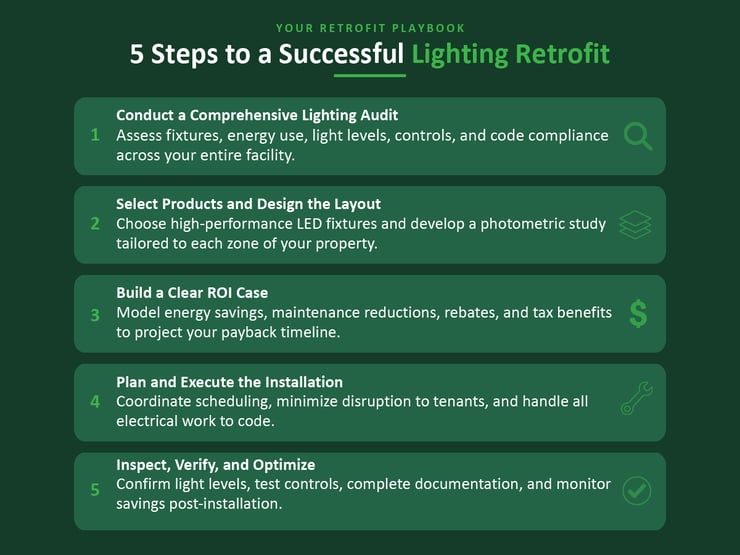
Follow our step-by-step guide to move forward with confidence, minimize disruption and start saving sooner.
The difference between a well-lit self-storage facility and a poorly lit one is as clear as day and night. Lighting is key for safety, security, curb appeal, lower operational costs, and improved customer satisfaction.
The reality is that no operators intentionally want a facility with flickering lights and dark alleyways, and many know that their aging fluorescent or metal halide systems are costing them money, and perhaps customers. But the idea of a full-scale retrofit can feel overwhelming.
The good news is that change doesn’t have to be difficult, and that with the right partner, the process is far more straightforward than most people expect.
As Greg Terry, director of strategic national accounts at US LED, observes, “ensuring that your property is well-lit, secure, and efficient is essential and within your control. You have the power to make positive changes that’ll help you attract and retain customers in a competitive industry.”
This step-by-step guide walks you through the entire retrofit journey, from your initial lighting audit to the final post-installation inspection, so you can move forward with confidence, minimize disruption and start saving sooner.
Step 1: Conduct a Comprehensive Lighting Audit
Every successful retrofit begins with a thorough assessment of your existing lighting system. A professional lighting audit gives you a clear, data-driven snapshot of where you stand today and what needs to change.
During a typical audit, a certified lighting professional will evaluate your facility's interior and exterior areas (hallways, individual units, drive aisles, stairwells, office spaces, and parking lots) while documenting fixture types, wattages, lamp conditions, control systems, and light levels. The goal is to identify inefficiencies, safety gaps, and areas where your current system may not meet light levels for self-storage facilities.
A quality audit should provide a holistic view and include:
-
Fixture inventory and condition assessment: Documenting every fixture across the property, noting technology type, and maintenance issues like flickering or burnout patterns.
-
Energy consumption analysis: Reviewing utility bills and metering data to establish your current baseline.
-
Light-level measurements: Using a light meter to determine whether critical areas meet recommended foot-candle levels for safety and security.
-
Controls evaluation: Assessing whether your facility uses any occupancy sensors, timers, daylight harvesting, or scheduling systems, and identifying opportunities to add them.
-
Code compliance review: Confirming that your lighting meets current local, state, and national electrical codes, and addressing any applicable light-pollution or Dark Sky requirements for nearby residential areas.
As an experienced LED provider, US LED offers on-site audits as part of its turnkey retrofit services. This expertise ensures nothing gets overlooked and gives you a solid foundation for the next step.
Step 2: Select the Right Products and Design the Layout
Not all LED solutions are created equal, and the lighting you choose will have a major impact on both performance and long-term value.
Self-storage facilities have unique lighting needs that vary significantly from one area to another. Interior hallways and unit corridors require uniform, consistent illumination. Drive aisles and exterior areas need durable wall packs and area lights rated for weather exposure. Office spaces call for flat panels or troffers that deliver comfortable, productive light.
Work with your lighting provider to develop a photometric study, a detailed lighting layout that maps recommended fixture placement, spacing, and light levels for each zone of your facility. This ensures your retrofit delivers optimal coverage without over-lighting or under-lighting any area.
When evaluating products, prioritize fixtures with long L70 lifetimes (the point at which light output drops to 70% of its original level), strong warranty coverage, and compatibility with smart controls. Ultra-long-life LED fixtures that approach or exceed 200,000-hour lifetimes eliminate the revolving door of lamp replacements and the labor costs that come with them.
Step 3: Build a Clear ROI Case
Once you have audit data in hand, the next step is translating those findings into a financial picture that makes the decision easy, whether you're the owner-operator or presenting to investors and stakeholders.
In a case study with Storage Asset Management (SAM), the successful installation of LED lighting reduced the property’s energy consumption by 64%.
For self-storage facilities, lighting often runs around the clock for security, which creates significant savings potential. A complete ROI analysis goes beyond energy savings. It should account for dramatically lower maintenance, including costs associated with replacing burned-out fluorescent tubes and failed ballasts. Moreover, it ought to include available utility rebates and incentives, and potential tax benefits like the 179D Commercial Buildings Energy-Efficiency Tax Deduction. Keep in mind that the current law includes a termination provision: 179D does not apply to property whose construction begins after June 30, 2026, so timing is critical.
When building your ROI projection, work with your lighting partner to model both the upfront investment and the projected payback period. It's common for self-storage LED retrofits to achieve full payback within two to four years, and in many cases faster, especially when rebates and tax deductions are factored in. Facilities with larger footprints or those still running older, less efficient systems will often see even more accelerated returns.
Don't overlook the softer benefits, either. Improved lighting quality enhances curb appeal, boosts tenant confidence, and supports better on-site security, all of which contribute to occupancy rates and long-term property value.
Step 4: Plan and Execute the Installation
With your design finalized and products selected, it's time to plan the installation itself. This critical step is where partnering with an experienced provider makes a significant difference.
A well-managed retrofit minimizes disruption to your daily operations and your tenants' experience. Your installation partner should coordinate scheduling to work around peak access hours, stage materials efficiently, and keep the job site clean and safe throughout the process.
For larger multi-site operators, a phased rollout (tackling one property or section at a time) can help spread costs while delivering immediate savings from each completed phase.
If your facility still uses legacy systems with ballasts, the installation team will need to address ballast removal or bypass as part of the fixture swap. A qualified provider handles all electrical work to code and ensures the new system integrates properly with any existing building management or controls infrastructure.
Step 5: Inspect, Verify and Optimize
The retrofit isn't complete when the last fixture goes up. A proper post-installation inspection verifies that everything was installed correctly, meets design specifications, and complies with all applicable codes.
This final step should include:
-
Light-level verification: Confirming that measured foot-candle levels across the facility match the photometric design.
-
Controls testing: Ensuring occupancy sensors, timers, and scheduling systems are functioning as intended and properly calibrated.
-
Visual inspection: Checking that all fixtures are securely mounted, properly aimed, and free of defects.
-
Documentation and warranty activation: Collecting all product documentation, warranty information, and as-built drawings for your records.
After sign-off, continue monitoring your energy bills over the first few months to confirm that actual savings align with projections. Most operators see the impact almost immediately, and the results tend to speak for themselves.
Make the Move
Upgrading your self-storage facility's lighting doesn't have to be complicated. With a clear process (audit, ROI, design, installation, inspection), the path from outdated lighting to a modern, efficient LED system is more manageable than you might think.
And the payoff is real: lower energy costs, reduced maintenance, better security, and a more attractive property for current and prospective tenants.
Contact US LED today to schedule a professional lighting audit and discover how a tailored retrofit solution can transform your facility's performance and your bottom line.