
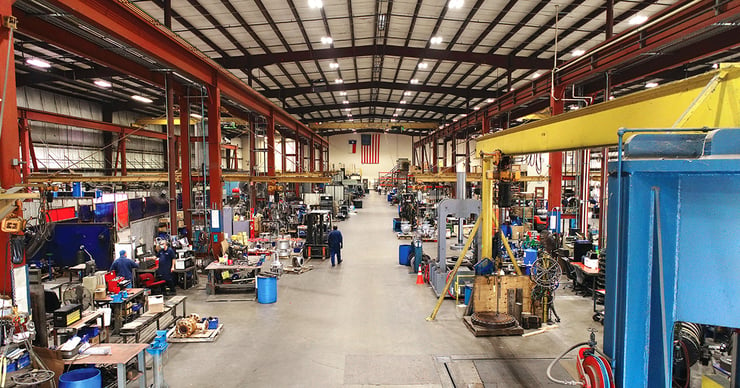
Industrial lighting is much more than the simple flip of a switch. Poor lighting contributes to accidents, headaches, eye strain, and other issues, while excessive brightness and glare can create their own safety hazards.
The International Labour Organization notes that one study suggests good lighting in factory settings can pay dividends, including up to a 10% increase in productivity and around a 30% reduction in errors with improved lighting.
Upgrading to LED lighting is one of the most straightforward ways for industrial and manufacturing facilities to improve working conditions, cut energy costs, and reduce maintenance requirements.
The payoff is real: energy savings of up to 75% compared to legacy fluorescent or HID lighting, dramatically longer lifetime, and better light quality across production floors, warehouses, and exterior areas.
Your industrial LED lighting upgrade, however, must be done right. Rushed planning, poor product selection, and overlooked details can turn a smart investment into an expensive lesson. Here are the most common mistakes to watch for and how to avoid them.
Skipping a Professional Lighting Assessment
The biggest mistake is also the most tempting: jumping straight into lighting selection without first evaluating what you have and what you actually need.
Industrial facilities are complex environments with varying ceiling heights, task-specific lighting demands, and mixed-use zones that range from high-bay production areas to office spaces, loading docks, and parking lots.
A proper lighting assessment accounts for all of it. It helps you:
-
Document details about the electrical system, like service panel locations and voltage.
-
Identify areas that are over-lit or under-lit and record light levels.
-
Highlight opportunities for controls integration and automation.
-
Confirm that the new layout will meet OSHA requirements and local building codes.
Without that baseline, you risk installing the wrong lights in the wrong places and spending months correcting the problems.
US LED offers professional lighting audit services and photometric lighting layouts designed to take the guesswork out of the planning process. Starting with expert analysis is the single best way to protect your investment from the outset.
Choosing Lighting Based on Price Alone
Industrial LED lighting can vary widely in price, and it is tempting to go with the lowest bid. But in manufacturing and warehouse environments, cheap lighting often means cheap components, and that translates to faster lumen depreciation, color shift, driver failures, and replacements far sooner than expected.
The real metric is total cost of ownership: purchase price plus energy consumption plus maintenance over the life of the lighting. A commercial-grade LED high bay that lasts 150,000 or 200,000 hours (L70) will far outperform a budget alternative rated for 50,000 hours, even if the upfront cost is higher.
Look for fixtures that are UL- or ETL-listed and DLC-qualified, which also ensures eligibility for utility rebate programs.
US LED’s industrial LED lighting, like the ExsaBay Xtreme Compact high bay, are engineered for ultra-long life and backed by an industry-leading Ten-Year Warranty, giving facility managers confidence in both performance and long-term value.
Ignoring Color Temperature and Light Quality
Not all light is created equal, and selecting the wrong color temperature is a surprisingly common oversight.
Correlated Color Temperature (CCT), measured in degrees Kelvin (K), affects visibility, worker well-being, and even productivity. A warm 3000K light might feel inviting in a lobby, but it does not provide the clear visibility needed for quality control inspections on a production line. Conversely, an overly cool 6000K (or higher) can cause eye strain and discomfort over long shifts.
For most industrial and manufacturing applications, 5000K CCT delivers the best balance of visibility and comfort, but it does come down to the end user’s preference. In fact, many modern LED luminaires now offer selectable CCT, allowing facility managers to dial in the right setting for each zone without ordering different SKUs.
US LED’s selectable CCT products, available across its indoor and outdoor lines, offer this flexibility to simplify specification and inventory management.
Overlooking Smart Controls and Automation
Installing high-efficiency LED luminaires without adding lighting controls is like buying a fuel-efficient truck and leaving it idling in the lot 24 hours a day. You capture some savings, but you leave a significant portion on the table.
Smart lighting controls, including occupancy sensors, daylight harvesting, dimming, and scheduling, can reduce lighting energy consumption by roughly 30% to 50% beyond the fixture upgrade itself, according to multiple industry studies and field demonstrations. In industrial settings with large square footage and variable occupancy (think warehouses, storage areas, and parking structures), the impact is even more pronounced.
To get the most from your controls strategy, consider:
-
Occupancy and vacancy sensors for intermittently used spaces.
-
Daylight harvesting in areas with skylights or windows.
-
Centralized scheduling and dimming for off-shifts and weekends.
US LED offers a range of lighting controls and sensors designed to integrate with its lighting, making it straightforward to layer automation into your warehouse lighting upgrade rather than treating it as an afterthought.
Failing to Account for Harsh Environments
Industrial facilities are not office buildings. Manufacturing areas may have high ambient temperatures, dust, moisture, chemical exposure, and constant vibration from heavy equipment. Lighting that performs well in a climate-controlled retail space could fail quickly under these conditions.
When specifying industrial LED lighting, pay close attention to IP (Ingress Protection) ratings, thermal management design, and vibration resistance. Fixtures with robust housings and properly sized heat sinks will maintain performance and lumen output far longer than “bargain” alternatives.
US LED designs and assembles much of its product line in Katy, Texas (just outside of Houston), with a focus on durability and quality assurance. The company’s industrial-grade lighting is built to handle demanding environments without sacrificing output or longevity.
Neglecting Exterior and Site Lighting
Many facility managers focus their industrial lighting retrofits on interior production and warehouse areas and treat exterior lighting as a secondary concern. That is a missed opportunity. Parking lots, loading docks, building perimeters, and walkways all benefit from the same energy savings and improved illumination that LEDs deliver indoors. More importantly, well-designed exterior lighting enhances employee safety and facility security.
Consider how exterior lighting supports:
-
Safe navigation for employees and visitors after dark.
-
Clear visibility for truck traffic at loading docks.
-
Deterrence and monitoring for security-sensitive perimeter zones.
Products like the Right Choice Series for area and site lighting, the EcoNight 4 wall pack for perimeter and building exterior lighting, and the Night Guard Flood Light give industrial facilities the coverage and performance they need outdoors, all with the same ultra-long life and low maintenance as interior solutions.
Not Taking Advantage of Rebates and Incentives
Utility companies and government programs routinely offer rebates and incentives for energy-efficient lighting upgrades, but many facility managers either do not know about them or fail to apply in time. These programs can significantly reduce the net cost of an LED retrofit, shortening payback periods to as little as one to two years.
To qualify, LED lighting typically needs to meet DLC standards, and applications often need to be submitted before installation begins. US LED’s rebate management services help facility managers identify available incentives and handle the paperwork, ensuring nothing gets left on the table.
Upgrading to Industrial LED Lighting with US LED
Upgrading to industrial LED lighting is one of the highest-ROI investments a facility can make, when it is planned and executed correctly.
A professional lighting assessment, long-lasting lighting rated for harsh environments, the appropriate color temperature, smart controls, and a strategy that includes exterior areas and available rebates all contribute to a successful project.
Partnering with US LED gives you access to expert design support, high‑performance lighting, and project management that simplifies everything from layouts to rebate paperwork.
Contact US LED today to discuss lighting solutions tailored to your industrial facility.